How Moments works
Three habits, none of them hard: record a moment when it surfaces, let the family add theirs, and ask whenever you want to hear one again. Everything below is in service of those three.
Step 1
Record, voice first
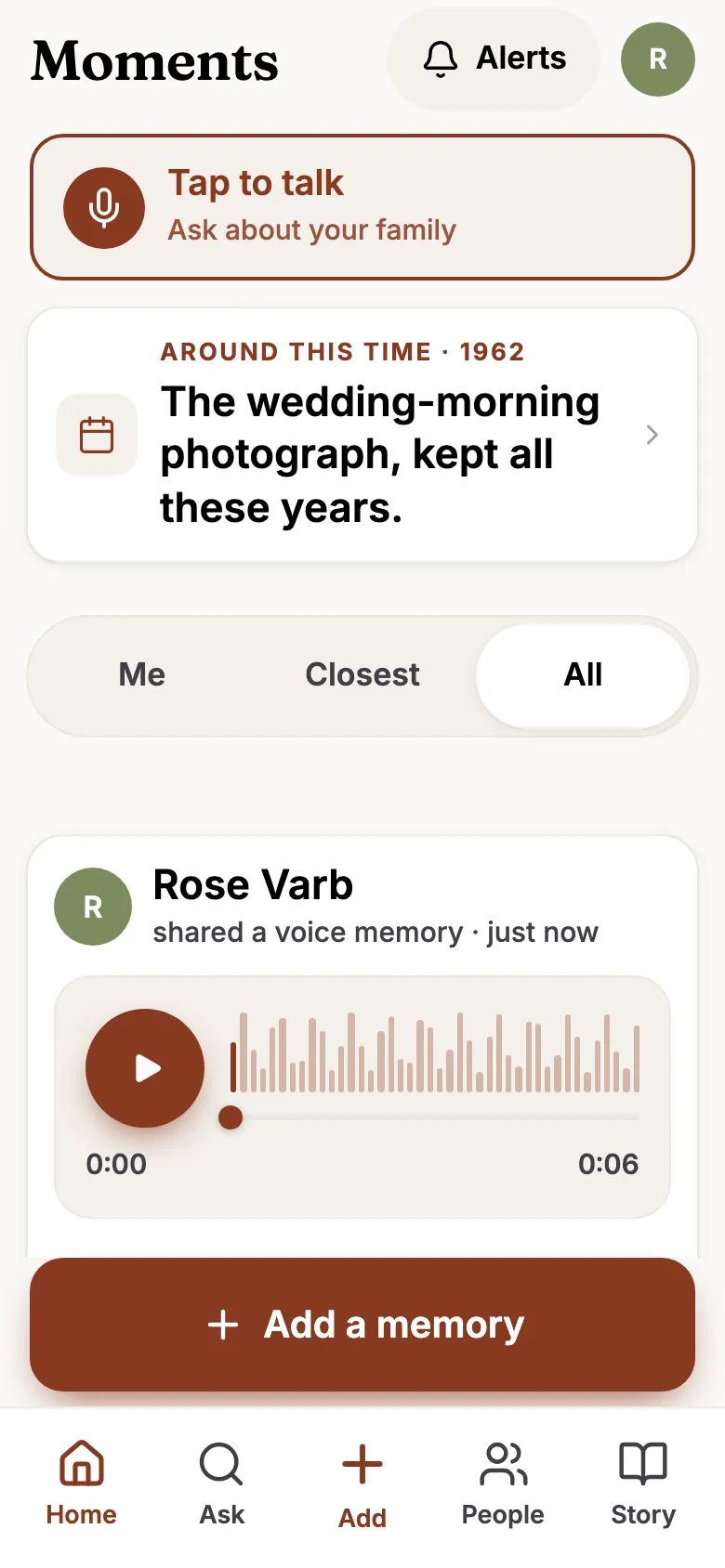
The heart of Moments is one big record button. Tap it, and let the story come out the way stories do: unpolished, with the pauses and the laughing in the right places.
Every recording is transcribed so it can be searched and read, and the original audio is always kept. The words matter, but the voice is the treasure.
Photos and text work too. Add the picture from the shoebox, note down the family recipe, or type the three lines you remember from a postcard. It all lands in the same archive.

A sample family

A sample family
Step 2
The family joins in
Invite family by email. Each person gets their own sign-in and adds memories from wherever they are; a sister in another country is two taps away from the same archive.
Everything gathers in a shared timeline, so a summer in 1974 sits next to last week’s christening. The family tree keeps people connected to their stories, so you always know whose voice you are hearing.
Only invited family members can see any of it. There are no public profiles and nothing is shared between families.
Step 3
Ask the Navigator
The Navigator is the part that feels like magic, built on something very plain: your family’s own recordings, photos and notes.
Ask in ordinary words. How did nana and papa meet? What was the farm like in winter? The Navigator answers from the memories your family has recorded, and every answer cites its sources, so you can tap through and hear the original telling.
If the family has not recorded something, the Navigator says so. It does not invent family history to fill a gap.

A sample family
One answer, taken apart
You ask in plain words
Tell me about Malle
It answers from what they really said
Malle is your grandmother and Taavi’s mother, born 12 March 1942. She met Villem at a Jaanipäev bonfire near Viljandi, worked as a seamstress for thirty years, and is remembered for her Singer machine, garden meals at the summer house, and listening intently whenever a brass band plays.
Based on 8 of 31 memories searched
And shows you where it came from
From these memories
- How Malle met Villem1961Her bicycle chain had slipped on the gravel road and a tall radio-school student crouched down and fixed it.
- The beach pavilion orchestra1949A brass orchestra playing at the pavilion while she stood in the sand holding her father’s thumb.
- Charcoal portraits of Malle2009
Built in
Elder Mode
Most family archives quietly assume the storyteller is thirty-five with perfect eyesight. Moments does not. Elder Mode is a comfort setting for the people with the best stories: bigger type, higher contrast, and simpler screens with one clear action at a time.
It is a mode, not a separate app. Flip it on in settings for anyone who wants it, and the whole app follows: same archive, same family, easier on the eyes and steadier under the thumb.
And if grandad would still rather not touch a phone at all, that is fine. A grandchild can sit beside him, press record, and let him talk. That counts too. Some of the best entries in any family archive are made by two people.
A sample family
Start with one story
You do not need a plan or a family meeting. Record one memory this week and show it to one person. Archives grow from there.
Ask for an invitation
Leave your email and we will write to you when a place opens.
Thank you.
We invite families in small batches. You will get an email with a sign-in link. iPhone builds go out separately by invitation.